You’ve already decided raclette is your thing. You’ve sat around someone else’s table, watched the cheese bubble and brown under the grill, and thought: I’m doing this at home. Now you’re looking at six different machines, a handful of accessories, and a rental option, and the specs are starting to blur together.
This guide maps every raclette machine in the Alpine Express range to the three situations we see most often: the couple’s night in, the family gathering, and the party host. We’ll cover dimensions, wattage, cheese format, total cost, and the honest case for renting before you commit. By the end, you’ll know exactly which machine suits your kitchen, your guest count, and your cheese preferences.
Before we get into specs, there’s one question worth answering first.
Which Situation Are You Shopping For?
Most people land on the wrong machine because they shop for the situation they imagine rather than the one they actually live. A quick self-assessment before you read any specs will save you a lot of scrolling.
The Couple or Small Group (1 to 4 guests, light meals, storage-conscious)You’re cooking for two most of the time, occasionally stretching to four. You want the experience without dedicating a shelf in the cupboard to it. Storage footprint matters to you, and you’d rather spend more on great cheese than on a machine you’ll only use at half capacity.
The Family Host (4 to 6 guests, main meals, authenticity matters)You host sit-down dinners regularly, and you want the real thing: a half wheel of Swiss raclette melting under the grill, scraped tableside while everyone watches. You’re willing to invest in a machine that delivers that experience properly, and you’ll use it often enough to justify it.
The Party Planner (8 or more guests, social melting, convenience first)You host large gatherings, or you’re planning one big event. You want a machine that can keep up with a crowd without requiring you to manage a half wheel at the same time as the conversation. Capacity and ease of use matter more to you than strict tradition.
Find yourself in one of these and skip straight to the bundle that matches. If you’re genuinely between two profiles, read both sections. The cheese format comparison in Section 4 will help you decide.
Every Alpine Express Machine, Side by Side
Here’s the full range. Every machine we stock, with the specs that matter for your decision.
| Model | Dimensions (H × Base cm) | Wattage | Guests | Cheese Format | SKU | Price |
|---|---|---|---|---|---|---|
| Ambiance Raclette Machine for 1/2 Wheels | 32 × 48 × 27 | 1000W* | 2 to 4 | 1 × half wheel | 999502 | $681.00 |
| Super Raclette Machine for Two 1/2 Wheels | 35 × 52 × 28 | 1000W* | 4 to 8 | 2 × half wheels | 999503 | $959.00 |
| Convivial Raclette Grill for Blocks | 22 × 34 × 17 | 450W* | 2 to 4 | Block (max 18 × 9 cm) | 999504 | $399.00 |
| 8 Person Indoor & Outdoor Raclette Grill by Swissmar | 16 × 47.4 × 25 | 1900W | 8 | Block / slice | SH75905 | $227.00 |
| Brio Plus Raclette Machine for Two 1/2 Wheels (Gas Operated) | 40 × 52 × 28 | 2600 to 3400W* | 4 to 8 | 2 × half wheels | 999512 | $1,511.00 |
| Easy Gas Raclette Machine for 1/2 Wheels (Gas Operated) | 32 × 43 × 28 | 2000 to 2500W* | 2 to 4 | 1 × half wheel | 999511 | $890.00 |
Important notes before you order:
- Super (SKU 999503) is currently out of stock and requires a special import order placed manually via contact with Alpine Express. It is not a standard add-to-cart purchase.
- 8 Person Indoor & Outdoor Raclette Grill by Swissmar (SKU SH75905) is currently available on back-order.
- Brio Plus (SKU 999512) is currently available on back-order and requires manual ordering.
- Easy Gas (SKU 999511) is currently out of stock. It is also restricted to outdoor use only and must never be operated inside your home or enclosed space.
- Brio Plus and Easy Gas do not include a pressure regulator or hose. These must be sourced separately before first use.
- *Wattage figures for TTM machines (Ambiance, Super, Convivial, Brio Plus, Easy Gas) are listed as per product specifications. Verify against current product pages before purchase. Swissmar Verso wattage (1900W) is confirmed on the product page.
What each machine is designed for
Ambiance ($681) is the core workhorse for anyone who wants the authentic half-wheel experience at home. It holds a single half wheel, tilts to keep the cheese face angled correctly under the 1000W element, and is built for regular use. If you’re the Family Host profile and you host 2 to 4 guests for sit-down raclette dinners, this is the machine most people in that situation end up with. It’s in stock, it ships with an Australian power plug, and the 2-year warranty covers material and production faults.
Convivial ($399) is the entry point for anyone who wants a genuine raclette experience without the price tag or storage footprint of a half-wheel machine. It holds pre-cut blocks (up to 18 cm long, 9 cm high) and sits at 22 cm tall with a base plate of 34 × 17 cm. For two people who host occasionally and want to keep things simple, this is the most practical machine in the range.
8 Person Indoor & Outdoor Raclette Grill by Swissmar ($227) is the most affordable machine for large groups. At 1900W and designed for eight people, it comes with eight heat-resistant spatulas and eight raclette dishes included in the box. It works with pre-cut cheese and is certified for both indoor and outdoor use. If you’re hosting a crowd and convenience matters more than tradition, this is worth considering. Note it is currently on back-order.
Super ($959) holds two half wheels simultaneously, making it suited to longer gatherings where you want continuous melting capacity across six to eight guests. The cast aluminium and natural stone base adds stability and a premium feel. It is currently out of stock and requires a special import order. If you’re considering it, contact Alpine Express directly.
Brio Plus ($1,511) is the gas-powered version of the Super format: two half wheels, indoor and outdoor approved, and capable of 2600 to 3400W output. It is designed for hosts who want the full authentic experience in spaces without easy power access, or who want the performance of gas at a large outdoor gathering. It is currently on back-order, requires manual ordering, and does not include a gas regulator or hose.
Easy Gas ($890) is the portable, gas-powered single half-wheel machine. It is outdoor use only, comes with a backpack that includes an insulated case for your half wheel, and runs on commercially available butane or propane. It is currently out of stock. Do not consider it for indoor entertaining.
Three Bundles, Real Prices
The machine price is only part of what you’ll spend to host your first raclette night. Here’s what each use case actually costs, with the cheese and accessories included.
Bundle 1: The Couple’s Night In
Machine: Convivial Raclette Grill for blocks
| Item | Detail | Price | |
|---|---|---|---|
| Convivial Raclette Grill for blocks | 450W, block format, 3.6 kg | $399.00 | |
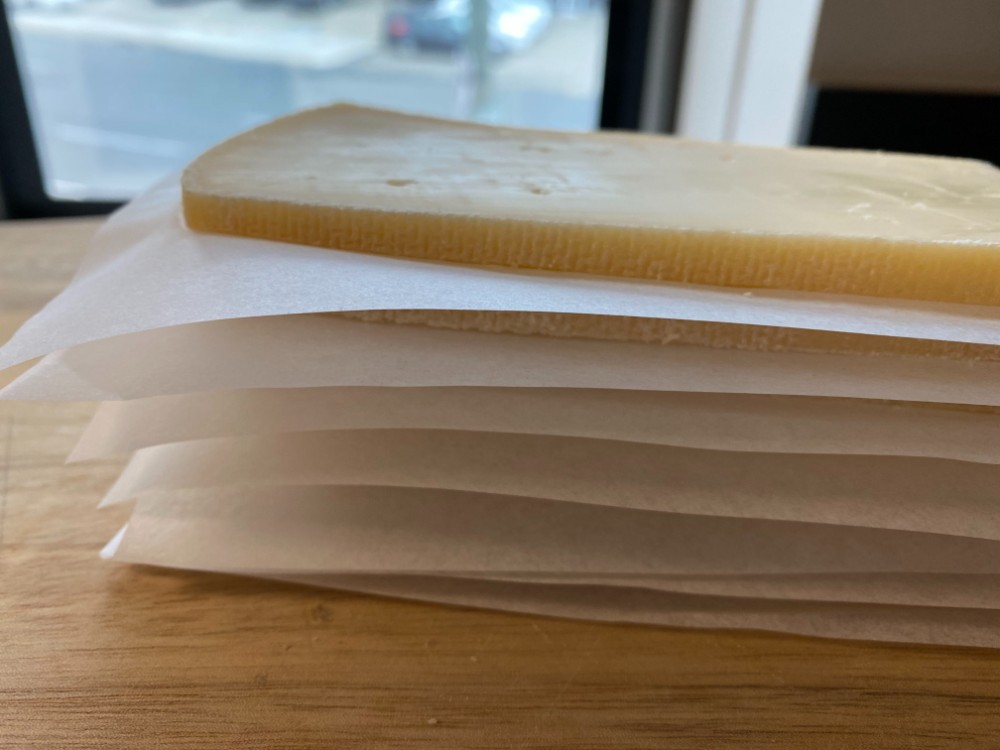
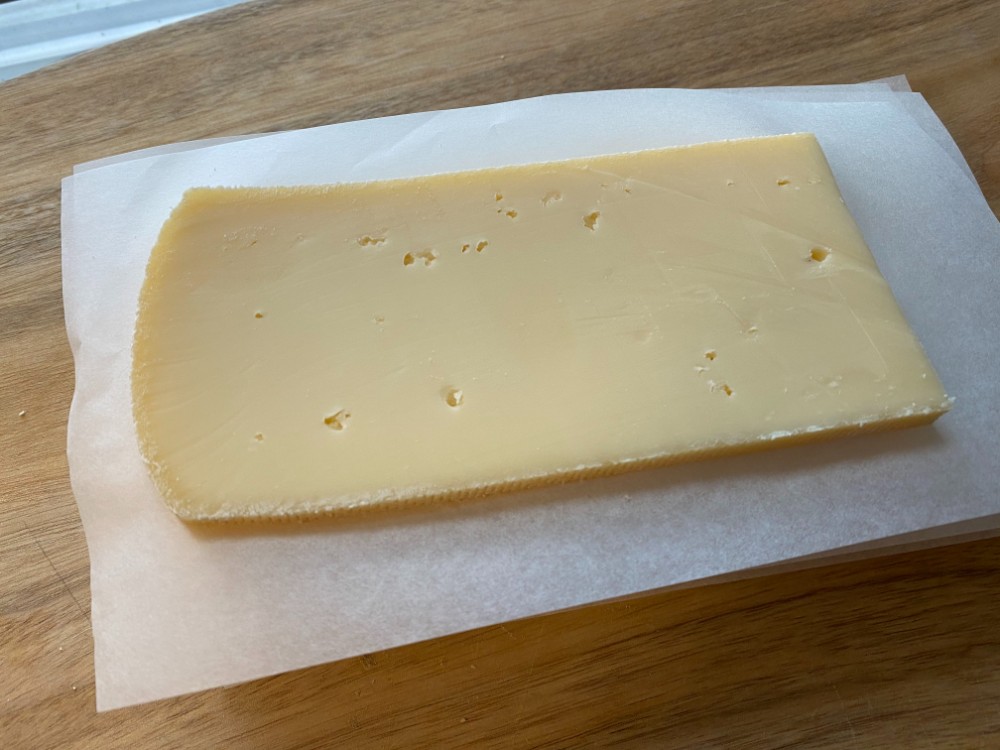
| Swiss Raclette Classic (sliced) | 300g, light meal for 2 (150g per person) | ~$18.90 | |
| Total (+ shipping) | ~$422.90 |
The Convivial includes a non-stick grill plate and a 360-degree swivel arm for the cheese holder. No additional accessories are required to get started. The machine packs down to 38 × 27 × 24 cm and weighs 3.6 kg, so it fits in a standard kitchen cupboard without rearranging anything.
Swiss Raclette Classic is pasteurised, gluten-free, and lactose-free with a mild, creamy flavour. It’s a good starting point if you’re new to cooking raclette at home.
At this order size, the Alpine Pass ($99/year for free shipping on orders $150 or more) is unlikely to pay back quickly. Standard shipping applies.
Bundle 2: The Family Gathering
Machine: Ambiance Raclette machine for 1/2 wheels
| Item | Detail | Price | |
|---|---|---|---|
| Ambiance Raclette machine for 1/2 wheels | 1000W, holds 1 × half wheel, 5.4 kg | $681.00 | |
| Swiss Raclette Classic (half wheel) | 1 kg, main meal for 5 (200g per person) | $63.00 | |
| PF-1 Single Cheese Holder | Spare holder, compatible with Ambiance | $141.00 | |
| Total (+ shipping) | ~$890.00 |
The 10% discount on raclette cheese that comes with your machine purchase must be placed as a separate order after you complete the machine checkout. It cannot be combined in the same transaction. After the discount, your cheese drops to approximately $56.70, bringing the total to around $878.70.
The PF-1 Single Cheese Holder is worth adding from the start. It gives you a spare if the included holder ever needs replacing, and it is compatible with the Ambiance.
If you’re planning to order cheese regularly, the Alpine Pass makes sense here. At $99 per year, free shipping on orders of $150 or more pays back after approximately 5–6 orders, given standard delivery runs from $5 for larger orders over $300.
Bundle 3: The Party Host
Two honest options, depending on what you’re optimising for.
Option A: The Social Melt (Budget-friendly, block format)
Machine: 8 Person Indoor & Outdoor Raclette Grill by Swissmar Best for: 8 guests, convenience, indoor or outdoor use
| Item | Detail | Price | |
|---|---|---|---|
| 8 Person Indoor & Outdoor Raclette Grill by Swissmar | 1900W, includes 8 spatulas and dishes | $227.00 | |
| Swiss Raclette Classic (sliced) | 2 kg, main meal for 8 (250g per person) | ~$126.00 | |
| Raclette knife | Dual-function stainless steel blade, rosewood handle | $59.00 | |
| Total (+ shipping) | ~$417.00 |
The Swissmar Verso includes everything you need for eight people in the box. No additional dishes or spatulas required. It is currently on back-order, so confirm availability before ordering. The Swissmar Verso is designed for pre-cut block and slice formats only. It does not accommodate half wheels. Its 1900W element and included eight-dish setup make it suited to social, high-capacity entertaining.
Option B: The Authentic Two-Wheel Experience
Machine: Brio Plus Raclette Machine for two 1/2 wheels (gas operated)
| Item | Detail | Price | |
|---|---|---|---|
| Brio Plus Raclette Machine for two 1/2 wheels (gas) | 2600 to 3400W, holds 2 × half wheels | $1,511.00 | |
| Swiss Raclette Classic (half wheels) | 2 × approx. 1.5 kg (2 kg total for 8 guests at 250g each) | ~$126.00 | |
| PF-2 Combi Cheese Holder | Double holder, compatible with Brio Plus | $198.00 | |
| Total (+ shipping) | ~$1,840.00 |
The Brio Plus does not include a gas regulator or hose. Budget an additional $30 to $60 to source these separately before your first use. After the 10% cheese discount on a separate order, your cheese cost drops to approximately $113.40, bringing the total to around $1,822.40 plus the gas components.
The Brio Plus is currently on back-order and requires manual ordering through Alpine Express. If you’re considering this machine, contact the team directly to discuss lead times.
Half Wheel or Block? What the Cheese Format Actually Means
This is the decision most buyers don’t realise they’re making until they’ve already ordered. It shapes the type of experience you’ll have, the cheese you’ll buy, and the machine you’ll need.
The half-wheel experience
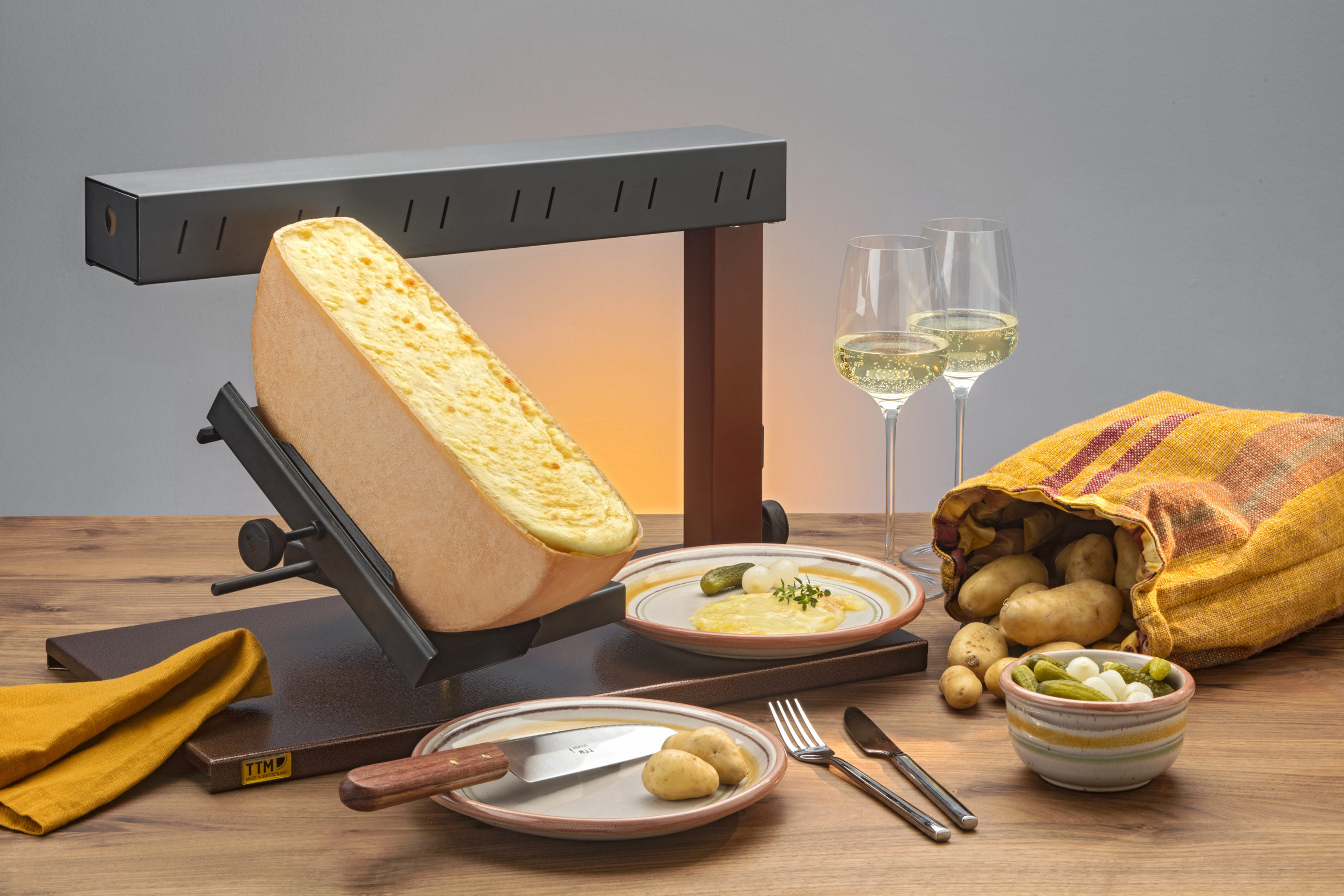
With a half-wheel machine (Ambiance, Super, Brio Plus, Easy Gas), a whole half wheel of Swiss raclette sits in the cheese holder, angled face-down toward the heating element. As the surface melts, you scrape it directly onto your guests’ plates. The wheel stays warm and continues melting throughout the meal. You scrape as you go. It is interactive, slow, and social in the best way. This is the traditional method found in Swiss chalets and mountain restaurants, and it is the reason raclette has the reputation it does.
The cheese cost for half-wheel format starts at $63.00 per kilogram for Swiss Raclette Classic. Buying in bulk half-wheel format is generally more economical per kilogram than pre-sliced portions. Verify current format availability and pricing on the Alpine Express website before ordering.
Half wheels require a little more preparation. They need to be kept at the right temperature before use and stored properly between sessions. They are larger than a block of sliced cheese, so you’ll want to plan your fridge space accordingly.
The block and slice experience
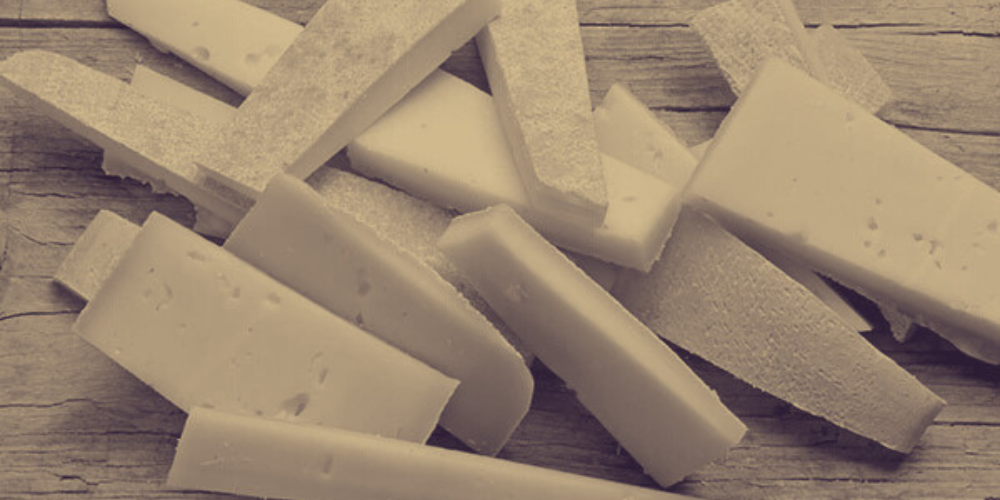
With a block or slice machine (Convivial, Swissmar Verso), pre-cut portions of cheese sit on the grill plate and melt from below. It is faster to set up, easier to portion for a crowd, and requires no special preparation beyond having the cheese ready to go. For a large group where you’re managing conversation and food simultaneously, this format is genuinely easier to run.
The trade-off is a different feel. You’re melting slices, not scraping a wheel. For some hosts, that distinction matters enormously. For others, it doesn’t matter at all, and what matters is that everyone at the table has melted cheese on their plate and is having a good time.
Neither format is inferior. They are different priorities. If the ritual of the half wheel is part of why you want to host raclette at home, a block machine will always feel like a compromise. If you want a relaxed, social meal where the cheese is delicious and the setup is simple, a block machine delivers exactly that.
Matching format to your profile
If you identified as the Couple or Small Group and you’re looking at the Convivial, you’re on the block path. That is a completely valid choice for two people who want a low-fuss, regular raclette night without the storage commitment of a larger machine.
If you identified as the Family Host and you’re considering the Ambiance, the half-wheel experience is exactly what that machine is built for. The $282 price difference over the Convivial buys you the authentic scraping ritual and the ability to use full Swiss half wheels.
Buy or Rent? The Honest Comparison
The Alpine Express raclette machine hire service was designed for a specific host: someone who wants to test the raclette experience before committing to a machine. If you’ve never hosted a raclette night at home and you’re not sure whether it will suit your entertaining style, renting before buying is a genuinely smart move. It also makes sense for one-off events where the machine is unlikely to see regular use afterward. A birthday dinner, a pre-Christmas gathering, a special occasion that doesn’t reflect your usual hosting pattern all fit this category.
What the rental includes and costs
The rental program is currently available for the Ambiance model only. The Super, Convivial, Swissmar Verso, Brio Plus, and Easy Gas are not available to rent. If you know you want a two-wheel machine or a gas-powered unit, buying is your only option.
A seven-day rental runs at $290 including GST, from the date of pick-up or arrival. A $550 bond applies on top of the rental fee. This is a significant upfront cost to plan for: your total outlay before the rental period begins is $840, with the bond returned after the machine comes back in good condition. Pick-up is free from Brisbane/Milton in Queensland. If you need the machine shipped, a flat $50 courier rate applies for most East Coast metro addresses. You can add the PF-2 Combi Cheese Holder for $95 if you’re cooking for a larger group and want to test the double-holder setup.
When buying makes more sense
The maths tip in favour of buying once you’re hosting three or more raclette nights per year. The Convivial at $399 is roughly the equivalent of one and a half rentals. Host twice in a year and you’ve recouped the purchase price. Host three times and you’re ahead, with no return deadlines, no bond to manage, and the machine sitting in your cupboard ready for the next one.
One other option worth watching: Ambiance ex-rental machines occasionally appear in stock at $449, compared to $681 for a new unit. These are used once, cleaned, checked, and sold in “as new” condition with a standard warranty. Availability is unpredictable, but if you’re drawn to the Ambiance and budget is a consideration, it’s worth checking the Alpine Express product listings periodically.
The simple heuristic: Three raclette nights per year is the threshold. Below that, rent and see how it feels. Above that, buy the machine that matches your use case and use it.
Safety and Care: What to Know Before You Switch On
A few straightforward habits will keep your machine running well for years and keep your 24-month warranty intact.
Safety
- Before plugging in, confirm your outlet matches 230V. All Alpine Express electric models (Ambiance, Super, Convivial, and the Swissmar Verso) operate at 230V and come with an Australian power plug.
- If you’ve chosen the Brio Plus or Easy Gas, the pressure regulator and hose are not included. Source these separately and follow the gas connection instructions carefully before first use.
- Never leave a running raclette machine unattended, particularly gas-powered units where an accidental bump could affect the flame or gas connection.
- The Easy Gas is outdoor use only. Never operate it inside your home or any enclosed entertainment area.
- When using any gas-powered machine, ensure adequate ventilation. Do not use gas machines in poorly ventilated spaces.
Cleaning and Care
- Allow the machine to cool completely before cleaning. The heating elements and stone base on machines like the Super and Brio Plus retain heat longer than you’d expect.
- Clean non-stick grill plates with a soft sponge only. Avoid abrasive cleaners, and never put any components in the dishwasher. Dishwasher damage is explicitly excluded from the manufacturer warranty.
- After each use, remove cheese residue from the cheese holders and scraping knife. A quick clean after every session prevents buildup that affects both performance and the flavour of your next gathering.
- Store your machine in a dry location. The Swissmar Verso is water-resistant. The TTM electric machines (Ambiance, Super, Convivial) and the gas models are not designed for outdoor storage.
On warranty: All Alpine Express raclette machines are covered by a 24-month manufacturer warranty backed by The Red Cow, covering material and production faults. Alpine Express facilitates the warranty process. Damage from improper handling or care is excluded, which is why the cleaning steps above matter. Burnt-out heating elements on the Ambiance and Super after more than 1,000 hours of use are also excluded from warranty coverage. For a home entertainer hosting a handful of times per year, that threshold is not a practical concern.
Your Decision: Which Machine Is Right for You?
You’ve seen the specs, the bundles, the cheese format tradeoffs, and the rental alternative. Here’s where it lands.
Choose the Convivial ($399) if you’re hosting one or two people, you want a light meal experience, storage space is limited, or you’re not yet sure how often you’ll use a raclette machine. It’s the lowest-commitment entry point that still delivers a genuine raclette experience.
Choose the Ambiance ($681) if you want the authentic half-wheel experience, you typically host two to four guests for main meal gatherings, and you value the social ritual of scraping a whole wheel at the table. This is the machine most Family Host profiles end up with, and it’s the right investment for anyone who’ll use it regularly.
Choose the Swissmar Verso ($227) if you regularly host eight or more guests, convenience and capacity matter more than strict tradition, and you want a machine that works both indoors and outdoors. At $227, it’s also the most accessible entry point for a large group. Note it is currently on back-order.
Choose the Brio Plus ($1,511) if you want the full authentic two-wheel experience, you host four to eight guests regularly, and you want the performance of gas for outdoor entertaining or spaces without easy power access. Budget for the gas regulator and hose separately. Currently on back-order, requires manual ordering.
Rent the Ambiance ($290 for 7 days) if you’re hosting a one-off event or you genuinely aren’t sure whether raclette will become a regular fixture in your entertaining rotation. Budget $840 total for the rental week ($290 rental fee plus $550 bond), with the bond returned after the machine comes back in good condition.
Browse the full Alpine Express raclette machine range with current pricing, dimensions, and availability, or pair your machine with the right cheese pack for your first gathering.